
Bereavement in the Workplace
Grief doesn’t clock out when you do
Grief can show up in places we spend most of our time- in our teams, our stations and our everyday routines. We spend a good amount of time with our colleagues and as a result they can become like a close extended family. Hence, the loss of a colleague can be deeply felt and the impact on co-workers can affect the wider workplace.
Why can this feel different?
Losing a colleague can feel unexpected and confusing. They were someone you saw, you may have not been particularly close, but they were a part of your day, someone worked alongside or shared small moments with. What makes it harder is that many of us don’t quite know what to do with grief at work. There’s this quiet, unspoken pressure to keep things moving forward, to stay professional, to not say the wrong thing and to carry on.
What might you notice?
Each person’s experience of grief is unique; however, there are some common experiences. You may find it difficult to:
· Sleep and eat
· Manage your usual workload
· Keep up with daily tasks
· Take care of your physical health
· Or believe you’ll come out the other side
These experiences are often quiet and not always visible and can have a wider impact than we realise.
Why this matters more than we think?
Grief in the workplace is more common than we often realise. In Australia, employees are typically entitled to just two days of compassionate leave, which doesn’t reflect the reality that grief doesn’t resolve quickly or follow a set timeline. Each year more than 1.6 million Australians experience bereavement and for many, this is something they navigate while continuing their day-to-day routines. In the workplace this can show up in small ways; changes in focus, energy or how someone shows up.
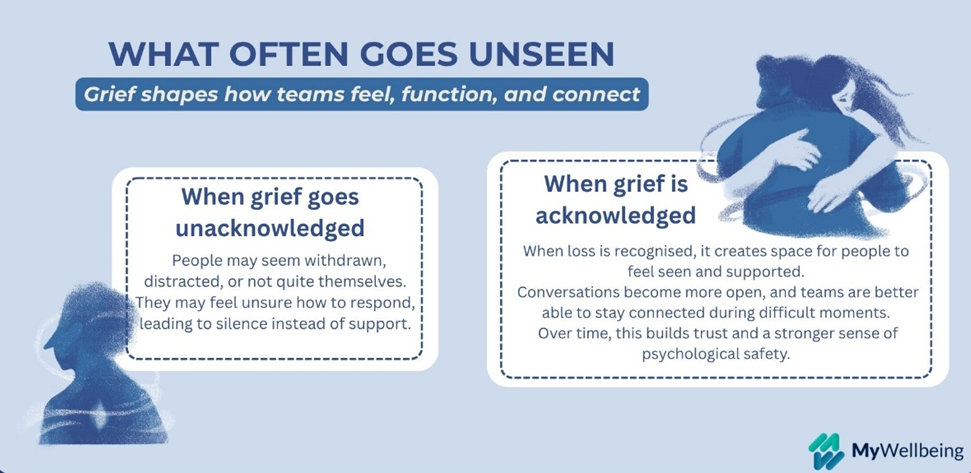
When someone on a team experiences a loss, it’s less about having the right answers and more about knowing how to show up and support them as they return. A big part of this is normalising conversations around grief, so people don’t have to carry it on their own.
So, what does this look like in practice, and where can you start?
Processing Grief with the TEAR model
Grief is deeply personal, and there’s no one way to go through it. The TEAR model is one approach some people find helpful as they make sense of loss and everything that comes with it.
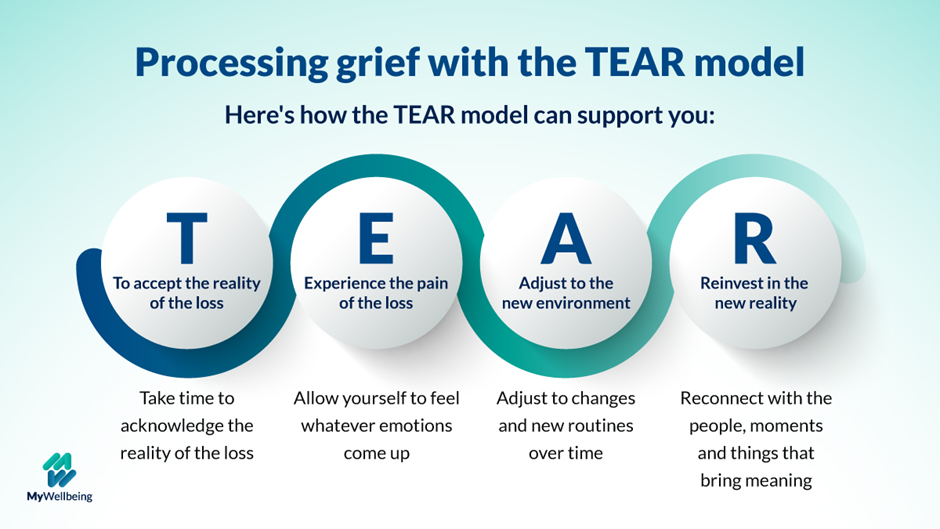
You don’t have to move through these steps in any order. As you go through them, you might find what feels right for you and take things at your own pace.
So, what does this look like day to day, especially when you’re trying to manage things at work?
How can we show up for ourselves and each other?
When it comes to showing up for yourself, often, it’s small actions that support you the most both at home, and in the workplace, consider:
· Maintaining your routine
· Keeping regular mealtimes
· Prioritising sleep
· Taking a moment to step away if you need it
· Giving yourself permission to feel whatever comes up, without rushing to move on
Reaching out to someone you trust, for a chat. Focusing on these small things may give you greater capacity to regulate your emotions throughout the day.
If you notice someone isn’t quite themselves, supporting them can be as easy as checking in. Starting with a simple “how are you going?” can open up a conversation. RU OK has a framework to having conversations with others.
People might respond with anger, confusion guilt, or distress, and not everyone will be ready to talk straightaway. Respecting that space is just as important as offering support.
Want to try something now?
If your grief feels overwhelming, small actions can help you feel more grounded. Techniques like box breathing, the five senses activity or journaling your thoughts can help you feel more grounded and in control.
Ultimately, the journey back to work while navigating loss looks different for everyone. There’s no right pace or a fixed timeline and you can choose to do what feels manageable in that moment.
Support is available
It’s important to reach out for support if you feel like your grief is making it hard to go about day-to-day life.
Through MyWellbeing, you can access a range of resources, complete a health screen to better understand how you are going, and access confidential coaching services for additional support through challenging periods.
If you’d prefer to speak to someone directly, you can also contact Wellbeing Services on 08 8995 5422 for confidential support and guidance.
If you need immediate support or would prefer to speak to someone outside of work, the following services are available 24/7:
Lifeline: 13 11 14
Beyond Blue: 1300 22 4636
13YARN: 13 92 76 (Aboriginal & Torres Strait Islander support)
MensLine Australia: 1300 78 99 78
Suicide Call Back Service: 1300 659 467
References
Bereavement in the workplace Grief Australia
Grief In The Workplace: Why Addressing Loss Can Be Good For Culture
How to support someone experiencing grief and loss
BHP Blog - Behavioral Health Partners (BHP) - URochester Medicine
When Grief Ripples Through A Community - A Note From Kate Cahill, Griefline CEO | Griefline